
Interview Analysis
Turning recorded conversations into structured, traceable evidence.
Most teams lose the thread between what a customer actually said and the decision that followed. Notes get summarized, context drops away, and weeks later the team is operating on a shared narrative that no one can trace back to source.
Interview Analysis preserves that chain — from recorded statement to structured evidence to hypothesis-level justification. Every conclusion stays anchored to what was actually said.
Instead of relying on notes or memory, the platform maintains a clear chain:
👉 Customer statement → Insight → Hypothesis → Decision
This ensures your thinking stays connected to real data, not assumptions.
How Interview Analysis Works
Once an interview is in the platform — whether from:
- Meeting Assistant
- Zoom Cloud Recording
- Simulated Interviews
- Manual Uploads
- Bulk Uploads
- In App Recording
It goes through the same analysis process.
The Analysis Pipeline
Interview Analysis runs through five distinct phases as your interview is processed. These phases are visible in real time and show how the platform moves from raw conversation to structured learning.
Phase 1: Analyzing the Overall Interview
The system first reviews the full conversation to understand the overall context.
This includes:
- What was discussed
- Who the participant is
- What the interview is trying to uncover
- The general direction and purpose of the conversation
This forms the foundation for the rest of the analysis.
Phase 2: Analyzing the Interview in Depth
The platform then analyzes the conversation in more detail.
This includes:
- Identifying key statements
- Extracting explicit and implicit signals
- Surfacing meaningful patterns
- Understanding important tensions, needs, or concerns
This is where raw conversation begins to become structured insight.
Phase 3: Connecting Insights with Your Canvas
The platform connects relevant insights to specific Canvas hypotheses.
For each linked insight, the system determines whether it:
- Supports a hypothesis
- Challenges a hypothesis
This connection helps drive:
- Supporting insight counts
- Non-supporting insight counts
- Validated hypotheses
- Invalidated hypotheses
- Evidence review on the Canvas
Phase 4: Assigning Tags to Insights
The system assigns relevant tags to insights so they are easier to organize, review, and compare.
Tags help categorize insights by topic, theme, or signal type, making it easier to identify patterns across interviews.
Phase 5: Generating Your Learning Brief
Finally, the system generates a Learning Brief.
The Learning Brief provides a concise summary of the most important learning from the interview. It helps users quickly understand what mattered most before reviewing the deeper analysis sections.
How Evidence Moves Through the System
Step 1 · Capture & Transcription
Interviews enter the platform in one of two ways:
- Meeting Assistant: The conversation is recorded directly inside Innovation Within and automatically attached to the interview.
- Zoom Cloud Recording (or other uploads): The recording is uploaded and attached after the meeting ends.
In both cases:
- The recording is attached to the correct interview
- The conversation is transcribed
- The transcript becomes available inside the interview workspace
From this point forward, the workflow is identical. If AI Analysis is enabled, the transcript is automatically analyzed.
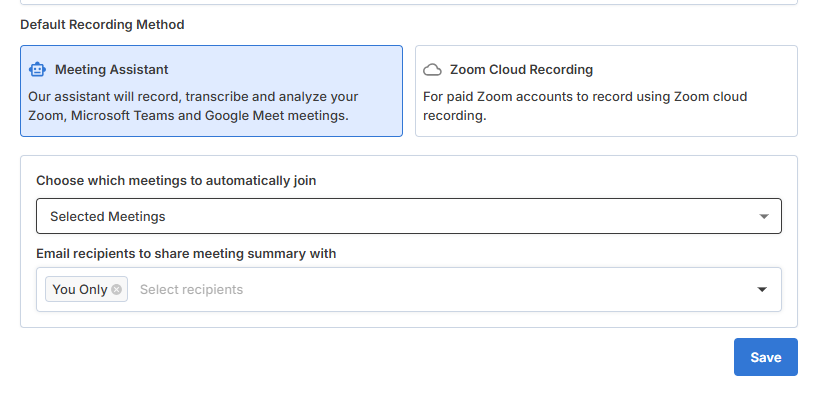
Recording Status Badge
When the Meeting Assistant is recording a meeting, a recording status badge appears in the platform.
The badge shows:
- The meeting currently being recorded
- The recording status
- The recording duration
- Controls to pause or end the recording, when available
This helps users confirm that the Meeting Assistant is actively recording and see how long the recording has been running.
Step 2 · AI Analysis
Once processing is complete, an AI Analysis tab appears inside the interview.
The system generates several layers of analysis, including a Learning Brief, Executive Summary, Explicit Insights, Implicit Insights, and Thematic & Meta Analysis.
Learning Brief
The Learning Brief gives you a concise summary of the most important learning from the interview.
It helps you quickly understand:
- The main takeaway
- What the interview suggests about your idea
- What you may need to review, validate, or question next
Start here when you want a quick understanding of the interview before reviewing the full analysis.
Executive Summary
A high-level overview of:
- What was discussed
- Key takeaways
- What it means for your idea
👉 Start here to quickly understand the interview.
Explicit Insights
These capture what the customer directly said.
Each insight includes:
- A clear title
- A structured description
- Supporting quotes (with audio playback)
- Linked Canvas hypotheses
- Whether it supports or challenges those hypotheses
- Tags and priority level
👉 These are your strongest, most direct evidence.
Implicit Insights
These capture what the customer revealed without explicitly stating.
Examples include:
- Hidden frustrations
- Tradeoffs
- Constraints or tensions
👉 These often provide deeper strategic signals.
Thematic & Meta Analysis
This is the highest-level synthesis.
It identifies:
- Patterns across the conversation
- Strategic implications
- Recommendations for positioning or direction
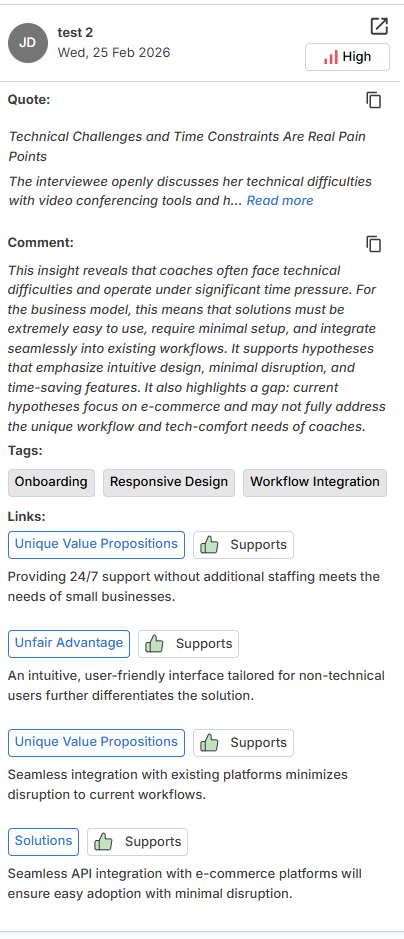
Compound Insights: Pattern and Evidence
Insights in the Analysis tab are structured as compound insights — a two-layer architecture designed to keep interpretation tethered to source material.
Each compound insight contains:
- Parent Insight — The interpreted pattern drawn from the conversation
- Sub-Insights — The quote-level evidence that supports that interpretation
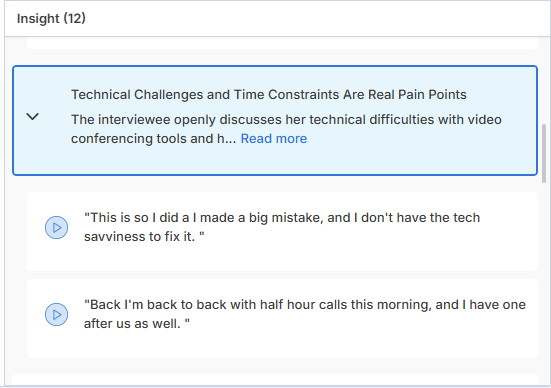
How this works in practice
Imagine you're interviewing a procurement director at a national lab. The AI generates a parent insight:
Price sensitivity is driven by procurement constraints, not perceived value.
The interviewee expressed strong interest in the platform's capabilities but repeatedly flagged annual budget cycles and sole-source thresholds as the real barriers to adoption. This suggests pricing strategy should target procurement compatibility rather than value justification.
That parent insight is supported by sub-insights — each containing a direct quote with audio playback:
"We have discretionary spend up to $10K, but anything above that triggers a full procurement cycle — we're talking six months minimum."
"It's not that we don't see the value. It's that I literally cannot cut a PO for this amount in Q3."
The sub-insights are the evidence. The parent insight is the interpretation. Both are preserved, and both are independently linkable to your Business Model Canvas hypotheses.
This structure prevents epistemic drift — the gradual, often invisible separation between what was actually said and what the team comes to believe over time. It happens naturally: a quote becomes a paraphrase, a paraphrase becomes a generalization, and within a few weeks the team is making decisions based on a narrative that no one can source. Compound insights keep the chain intact.
Parent Insight (Pattern-Level)
Includes:
- A headline and detailed description
- Linked sub-insights (supporting quotes)
- Which hypotheses it is linked to
- Whether it supports or challenges those hypotheses
- Categorization, priority, and reasoning behind classification
A single insight can link to multiple hypotheses — one customer statement may affect your Customer Segment, Value Proposition, Pricing, or Revenue Model simultaneously.
Sub-Insights (Quote-Level Evidence)
Each sub-insight:
- Contains a direct quote snippet with audio playback
- Seeks to the exact transcript timestamp
- Is a full insight object, not just a reference
Sub-insights can independently:
- Link to one or multiple hypotheses
- Support or challenge assumptions
- Be categorized and prioritized on their own
Every interpretation remains anchored to recorded source material.
Step 3 · Linking Insights to Your Canvas
Every relevant insight — parent or sub-insight — can be linked to one or more Business Model Canvas hypotheses.
When viewing your Canvas, each hypothesis displays:
- Number of supporting insights
- Number of contradictory insights
These indicators reflect accumulated evidence across interviews.
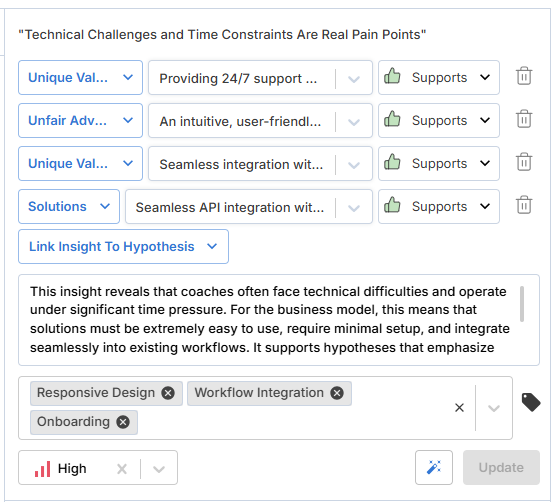
Opening a hypothesis allows you to:
- Review all linked insights
- See which support or challenge the assumption
- Play the exact audio behind any insight
- Jump directly to transcript context
- Decide whether to validate, revise, or invalidate the hypothesis
Your Canvas becomes a living evidence map rather than a static list of assumptions. Over time:
- Patterns strengthen
- Contradictions become visible
- Confidence shifts as evidence accumulates
How Do I Know When Analysis Is Complete?
Once your interview has been processed, you’ll receive an in-platform notification when AI analysis is complete.
This notification includes:
- The number of insights generated
- A direct link to the interview
- A quick way to navigate to your Canvas
You can click the notification to immediately:
- Open the analyzed interview
- Review the generated insights
- Start linking evidence to your hypotheses
👉 If you don’t see analysis right away, it may still be processing. Once complete, the notification will appear automatically.
Important: AI Does Not Make Decisions
Interview Analysis:
- Does not automatically validate your ideas
- Does not replace your judgment
It provides structured evidence so you can make better decisions.
👉 You are always responsible for interpretation.
Decision Workflows
Evaluating a hypothesis
- Open the Canvas → select the hypothesis → review supporting and contradictory evidence
- Pay particular attention to whether supporting evidence comes from multiple independent interviews or repeats of a single signal
- Decide whether to validate, revise, or invalidate
Detecting structural model weakness
- Look for high-priority contradictions, especially insights linked across multiple hypotheses
- When a single insight touches your Customer Segment, Value Proposition, and Revenue Model simultaneously, it often indicates a structural issue — not just a data point to address in isolation
Improving positioning or messaging
- Review explicit customer language inside linked insights
- The strongest positioning often uses phrasing customers already use to describe their own problems
- Direct quotes are more credible and more precise than team-generated language
Prioritizing product decisions
- Sort insights by priority and look for repeated high-signal tensions across interviews
- A single strong quote is a data point; the same tension surfacing across three or four interviews is a pattern worth acting on
Best Practices
- Review insights across multiple interviews, not in isolation
- Look for repeated patterns rather than single anecdotes
- Pay attention to high-priority contradictions
- Revisit your Canvas regularly as evidence accumulates
- Notice when a single insight affects multiple hypotheses — these often indicate structural model issues that deserve attention before individual features or messaging changes
Decisions improve when evidence accumulates visibly rather than relying on memory or intuition.
Frequently Asked Questions
Do I need to tag speakers or clean transcripts first?
No. The system auto-detects speakers, structures the transcript, and allows edits if needed.
What if the interview is informal or messy?
The analysis is designed for real-world conversations, including tangents and incomplete thoughts.
Can I edit insights or their hypothesis links?
Individual insights and their Canvas links are editable. Meta analyses are not editable.
How should I handle insights I disagree with?
That's expected and healthy. AI-generated insights are starting points for reasoning, not conclusions. If an insight feels wrong, interrogate why:
- Is the quote being misinterpreted?
- Is the pattern real but the framing off?
- Does disagreeing reveal an assumption you hadn't articulated?
Edit the insight, reframe it, or discard it. The system is designed to support your judgment, not replace it.
When do I have enough evidence to validate or invalidate a hypothesis?
There's no universal threshold, but useful heuristics include:
- Can you identify the same pattern across three or more independent interviews?
- Does the supporting evidence come from the right customer segment?
- Are there zero strong contradictions, or have the contradictions been accounted for?
If you can articulate why you believe the hypothesis is validated — with traceable evidence — you're in a defensible position. If the justification relies on a single strong anecdote or a general feeling, keep gathering.
Can insights from different interviews contradict each other? Y
es, and this is one of the most valuable signals the system surfaces. Contradictions across interviews often reveal:
- Segment differences
- Context-dependent behaviors
- Hypotheses that need refinement rather than simple validation
When you see conflicting evidence on your Canvas, resist the urge to pick a side prematurely — instead, ask what conditions would make both statements true.
Is my data secure?
Transcripts and analyses remain inside your Innovation Within workspace and are not used to train models. Data is encrypted in transit and at rest.
Interview Analysis is designed to improve how your team learns from customers. By preserving the full chain from conversation to conclusion, it reduces epistemic risk and strengthens the justification behind your decisions.
Some cohorts may have AI features disabled, ask your administrators if you believe this is a mistake.