
What Is an Insight and Why It Matters
An Insight captures what you learned from a customer conversation as structured evidence — not just what someone said, but why it matters and what it means for your assumptions.
Insights exist to turn raw conversations into decision-ready learning.
Instead of scattered notes, highlights, or opinions, Insights help you:
- Capture real customer perspectives
- Connect those perspectives to specific hypotheses
- Build confidence in what to validate, change, or discard
This is the bridge between talking to customers and making evidence-based decisions.
Why Insights Exist
Customer discovery generates massive amounts of unstructured information — conversations, observations, notes, recordings. Without a systematic way to capture what you learn, critical findings get lost, patterns go unnoticed, and teams can't build on each other's work.
Insights turn raw conversations into decision-ready learning by:
- Creating shared language: Everyone sees exactly what was said, who said it, and what it means
- Linking evidence to decisions: Every strategic choice traces back to the customer evidence behind it
- Tracking confidence over time: As you gather more evidence, you can see how your understanding evolves — and where gaps remain
Without Insights, teams often feel like they've learned something — but can't clearly explain what, why, or how confident they should be. With Insights, learning becomes visible, traceable, and actionable.
Insights vs. Notes: What's the Difference?
A note records information. An Insight explains significance.
An Insight doesn't just capture what was said — it structures why it matters. Each one includes:
- A quote or observation from a transcript, note, or recording
- Context explaining why this matters to your business
- Linked hypotheses connecting the evidence to one or more assumptions on your Canvas
- Evidence direction — does this support or challenge the hypothesis?
- Priority level (Critical, High, Medium, Low)
- Tags for categorization and pattern recognition
This structure turns qualitative feedback into organized, comparable evidence.
Two Ways Insights Are Created
Insights can be created manually or generated by AI. Both produce the same structured outcome — the difference is how the work happens.
Creating Insights Manually
Manual creation is especially valuable in learning-focused cohorts or when teams want to build strong customer discovery habits.
The process is straightforward:
- Select a meaningful moment from a transcript or note
- Link it to one or more hypotheses
- Indicate whether the evidence supports or challenges each hypothesis
- And add context, tags, and priority.
This encourages intentional thinking at every step — why does this matter? What assumption does it test? How important is it?

AI-Generated Insights
When AI is enabled, Innovation Within analyzes interviews and presents the results in a dedicated analysis tab with four sections:
- Executive Summary — a comprehensive write-up of what actually happened in the interview. This isn't a typical note-taker summary — it captures the substance of the conversation, including context, nuance, and significance.
- Explicit Insights — findings drawn directly from specific statements in the conversation. Things a customer said clearly and unambiguously.
- Implicit Insights — patterns and findings that emerge across the conversation rather than from any single statement, capturing meaning that wasn't stated directly but surfaced through the overall arc of the discussion.
- Thematic Analysis — a meta-analysis that asks: What does this really mean for your business model? How should this change the way you think about your assumptions?
Every insight across all three sections is a compound Insight: a synthesized description of the finding, with the actual quotes from the conversation nested underneath as individual sub-insights. Each sub-insight is structurally identical to a manually created Insight — linked to hypotheses, with context, evidence direction, priority, and tags. AI simply performs the work at scale.
Together, the analysis tab moves from what was said → what it means → what it means for your business — with full traceability from any conclusion back to the source evidence.
Because manual and AI-generated Insights share the same structure, teams that start manually build intuition for what good evidence looks like — and can evaluate AI-generated Insights with a critical eye.
The Insights View
The Insights View is your centralized evidence library — a single view that brings together every Insight across all interviews, whether created manually or by AI.
You can search and filter by category, priority, hypothesis, or evidence direction, making it easy to see which assumptions have strong support, which are being challenged, and where you still have gaps. Compound Insights appear with a disclosure triangle you can expand to see the supporting sub-insights underneath.
From any Insight, you can navigate directly to the source moment in the underlying interview — so you're never more than a click away from the original context.
-
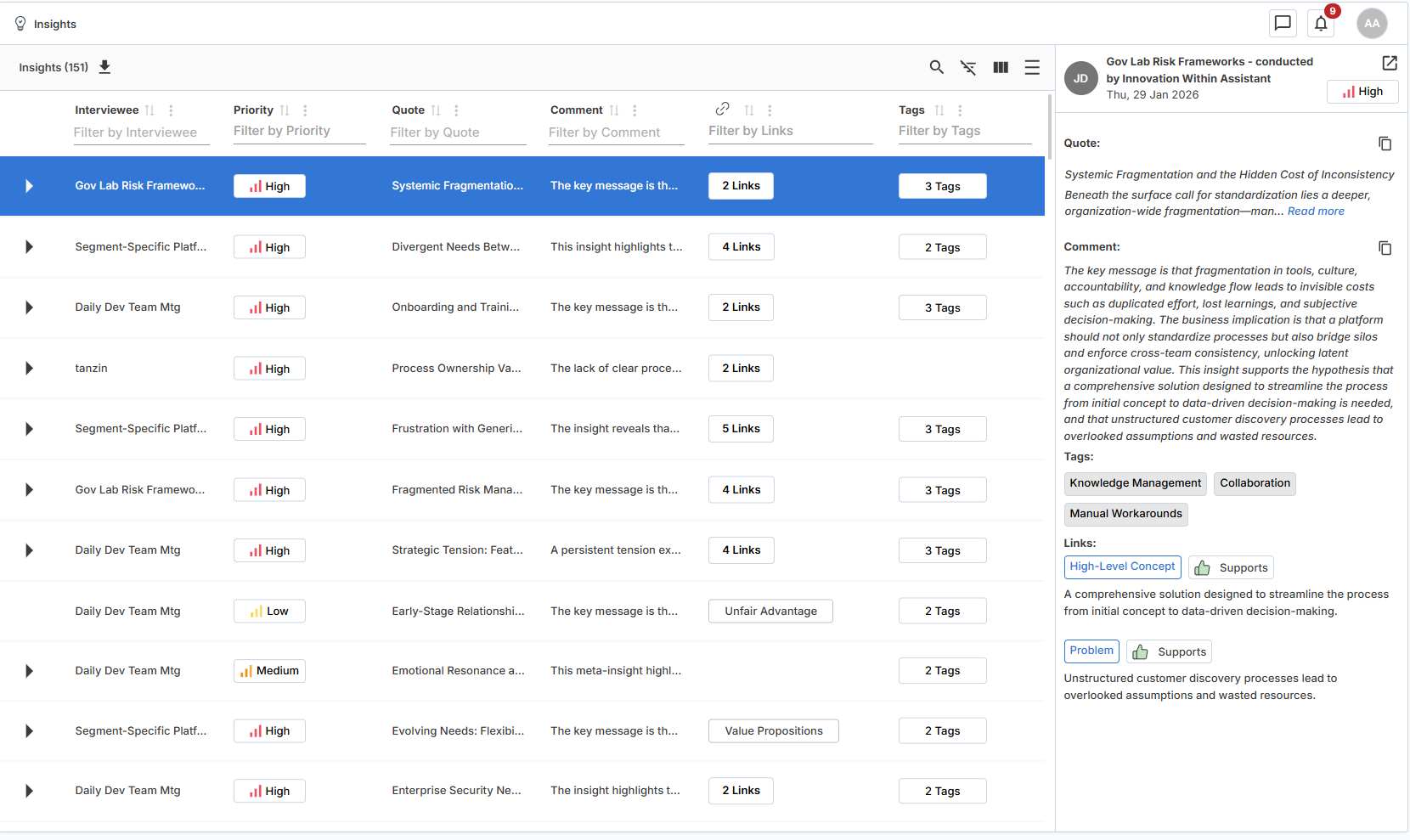
Insight Table View
Key Takeaway
Insights exist so teams don’t just talk to customers — they learn from them in a structured, repeatable way.
Whether created manually or generated by AI, Insights turn conversations into clarity, assumptions into evidence, and discovery into direction.
Once you understand what an Insight truly is, the rest of the platform — Canvas, hypotheses, validation, and decision-making — starts to click into place.