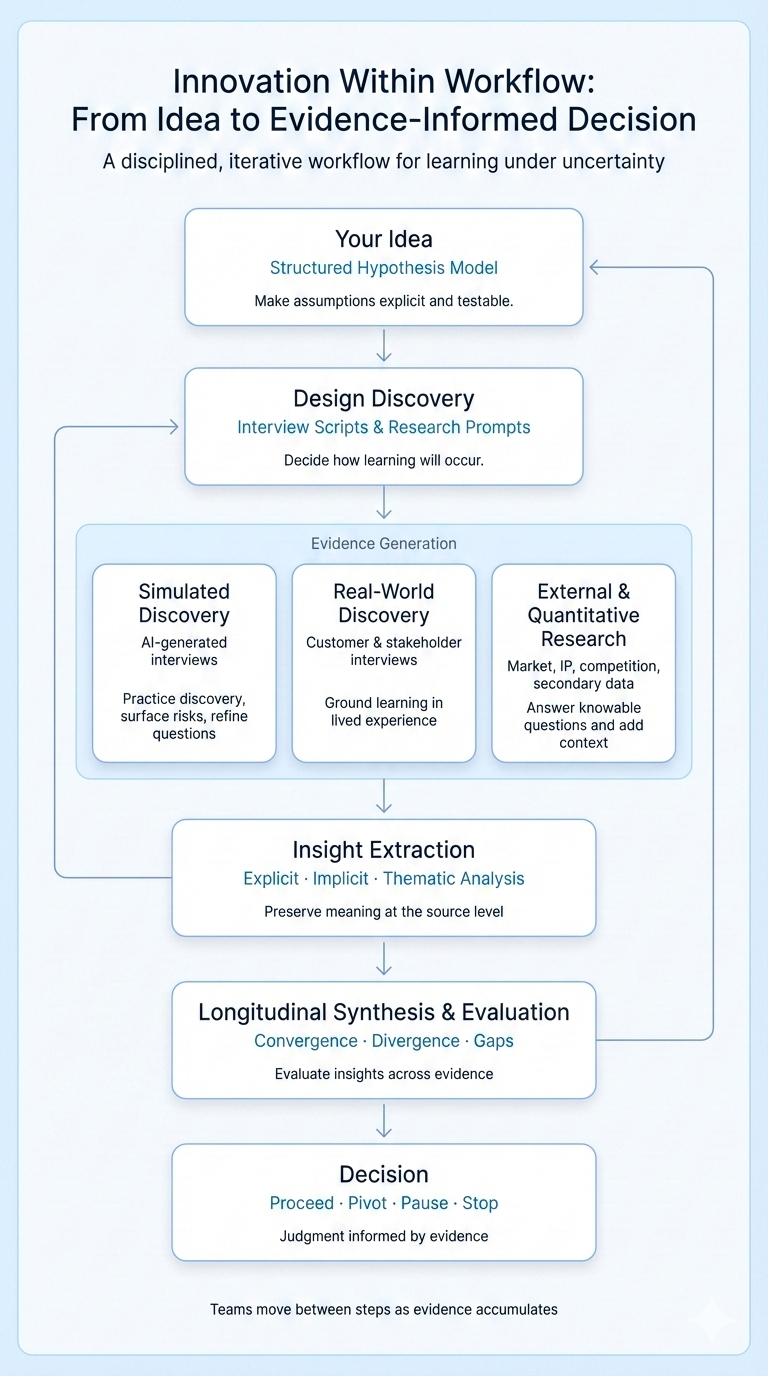
From Idea to Evidence-Informed Decision
What this workflow is for
This workflow describes how teams use the platform to turn ideas into evidence-informed decisions.
It is designed to support:
• Enterprise innovation and portfolio decisions
• Venture programs and academic cohorts
• Founders practicing disciplined discovery
The workflow emphasizes learning, evidence, and judgment, rather than prediction or automation.
How to read this workflow
The steps below describe a typical progression.
In practice, teams often move between steps as evidence accumulates.
The platform is designed to support iteration without losing context, traceability, or rigor.
Think of this as a logical sequence, not a rigid checklist.
The Core Progression
1. Idea to Hypothesis Model
Ideas begin as assumptions.
In this step, your idea is translated into a structured hypothesis model that makes assumptions explicit and testable. The model defines what must be learned before a decision can be made.
Purpose: Make assumptions visible
Produces: A hypothesis model (canvas)
2. Design Discovery Instruments
Hypotheses shape what questions are worth asking.
In this step, the platform generates interview scripts and research prompts aligned to the current hypothesis model. These instruments ensure that evidence is collected intentionally rather than opportunistically.
Purpose: Design how learning will occur
Produces: Interview questions and research prompts
3. Generate Simulated Discovery Evidence
Before engaging real participants, teams may use simulated discovery to explore assumptions and practice the discipline of discovery.
Simulated discovery helps surface risks, refine questions, and accelerate learning—especially early in the process.
Purpose: Accelerate early learning and question quality
Produces: Simulated interviews and insights
4. Collect Real-World Evidence
Real-world discovery grounds hypotheses in lived experience.
In this step, teams conduct interviews with customers, users, or stakeholders. Conversations are recorded, transcribed, and prepared for analysis.
This step is central to validating or contradicting assumptions.
Purpose: Gather qualitative evidence from reality
Produces: Interview recordings and transcripts
5. Acquire External & Quantitative Evidence
Not all important questions require interviews.
In this step, teams gather external and secondary evidence such as market research, competitive analysis, funding data, IP research, or domain-specific reports.
This is especially valuable for feasibility assessment, technology transfer, and early screening decisions.
Purpose: Answer knowable questions and provide context
Produces: Research documents and data sources
6. Extract Insights from Evidence
Evidence becomes useful only when interpreted.
In this step, individual interviews and documents are analyzed to extract:
• Explicit insights
• Implicit insights
• Thematic mets insights
Our AI will automatically link Insights to hypotheses when relevant.
This step occurs continuously as new evidence is added.
Purpose: Preserve meaning at the source level
Produces: Structured insights
7. Synthesize Insights & Evaluate Hypotheses
Synthesis looks across evidence.
In this step, the platform analyzes patterns across multiple sources to identify:
• Converging signals
• Diverging signals
• Unresolved uncertainty
• Evidence gaps
This synthesis supports informed judgment about whether to proceed, pivot, pause, or stop.
Purpose: Support decision-making
Produces: Cross-source analysis and decision support
Iteration is expected
Teams commonly:
• Revise hypotheses after early evidence
• Refine questions as insights emerge
• Alternate between qualitative and quantitative research
• Return to synthesis multiple times before deciding
The workflow is designed to support this movement while maintaining traceability between:
• Assumptions
• Evidence
• Insights
• Decisions
What this workflow is not
This workflow is not:
• A guarantee of success
• A linear checklist that must be followed once
• An automated decision system
It is a disciplined way to learn under uncertainty.
How different teams use this workflow
• Enterprise teams use it to manage risk, allocate resources, and make portfolio decisions
• Programs and cohorts use it to teach evidence-based innovation
• Founders use it to replace intuition-driven decisions with learning
The underlying workflow is the same.
The depth and rigor vary by context.
Where to go next
• Start with Step 1: Frame the Idea as a Hypothesis Model
• Or jump directly to any step based on your current stage